
show me the bill of rights
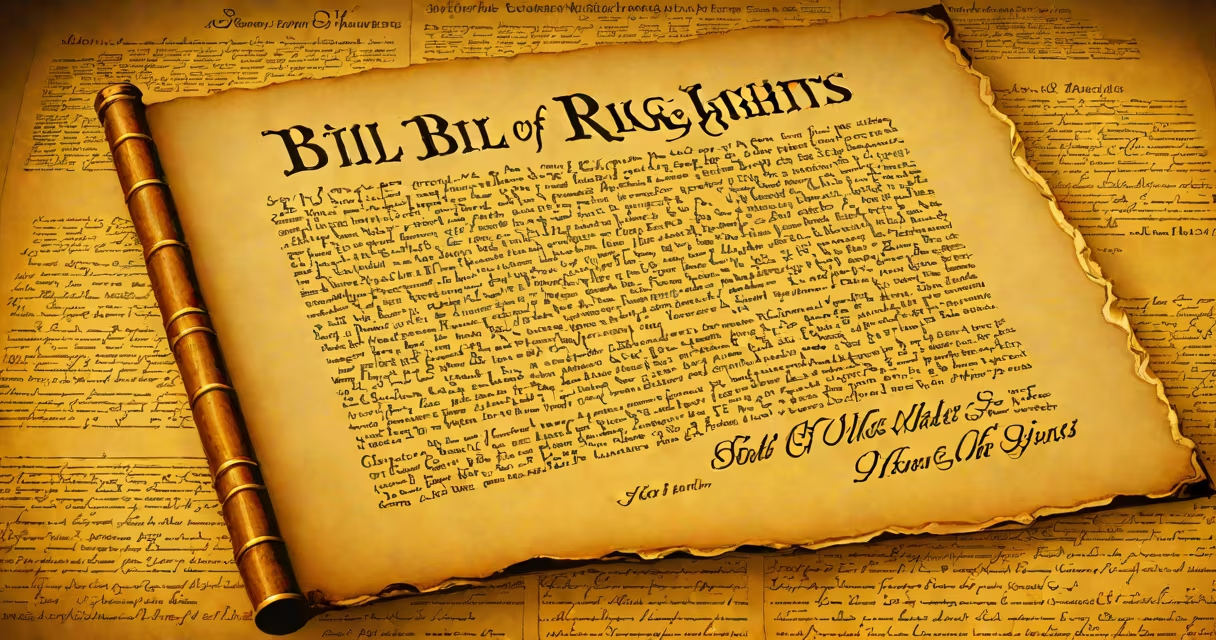
The Bill of Rights is the first ten amendments to the United States Constitution, ratified in 1791. These amendments guarantee individual liberties such as freedom of speech, religion, and assembly, and protect citizens from government overreach.
These amendments were added to address concerns raised during the ratification debates. Federalists argued the original Constitution gave enough power to the federal government, but Anti-Federalists insisted on explicit protections for personal rights. The result was a compromise: Congress proposed twelve amendments in 1789, and ten were ratified by the states by December 1791.
Each amendment addresses a specific right or limitation on government power. For example, the First Amendment prohibits Congress from making laws respecting an establishment of religion or restricting free speech. The Fourth Amendment prevents unreasonable searches and seizures. The Ninth Amendment clarifies that the enumeration of certain rights does not deny others retained by the people.
How the Bill of Rights Works
The Bill of Rights functions as a legal check on federal authority. When government actions infringe on protected rights, courts can strike them down under the Constitution. This system of judicial review helps laws and policies comply with foundational civil liberties.
For instance, in *Tinker v. Des Moines Independent Community School District* (1969), the Supreme Court ruled that students wearing black armbands to protest the Vietnam War had a First Amendment right to symbolic speech. The Court held that schools cannot suppress student expression unless it causes substantial disruption.
Amendments apply only to federal actions initially. But through the Fourteenth Amendment's Due Process Clause, most protections have been incorporated and applied to state governments since the early 20th century. This means a state cannot ban religious practice, even if local law allows it.
What the Bill of Rights Is Made Of
The Bill of Rights consists of ten distinct amendments, each with a unique focus. They cover rights related to expression, privacy, fair trial, and property.
| Amendment | Key Right | Real-World Example |
|---|---|---|
| First | Freedom of speech, religion, press, assembly, petition | A church sued a city over a zoning denial for a new building; the court ruled the denial violated the Free Exercise Clause. |
| Second | Right to keep and bear arms | In *District of Columbia v. Heller* (2008), the Supreme Court upheld an individual's right to possess a firearm for self-defense in the home. |
| Third | Prohibits quartering soldiers in private homes | Used rarely, but cited in cases involving military occupation of civilian space during emergencies. |
| Fourth | Protection against unreasonable searches and seizures | A warrantless search of a car during a traffic stop was ruled unconstitutional in *Arizona v. Gant* (2009). |
| Fifth | Due process, protection against double jeopardy, self-incrimination | A suspect invoked the Fifth Amendment during a criminal trial, leading to dismissal of charges based on lack of evidence. |
| Sixth | Right to a fair and speedy public trial, legal counsel | Indigent defendants are entitled to court-appointed lawyers under *Gideon v. Wainwright* (1963). |
| Seventh | Right to jury trial in civil cases | Disputes over contracts or property damage may require a jury trial if the claim exceeds $20. |
| Eighth | Prohibits cruel and unusual punishment, excessive bail or fines | Life without parole for a juvenile offender was struck down in *Miller v. Alabama* (2012). |
| Ninth | Recognizes unenumerated rights retained by the people | Courts have used this to support privacy rights, including reproductive autonomy. |
| Tenth | Reserves powers not delegated to the federal government to the states or the people | States regulate education and driver licensing under this principle. |
Not all rights are absolute. Courts balance individual freedoms against public safety, national security, and other interests. For example, free speech does not protect threats, obscenity, or incitement to violence.
Where and Why It's Used Today
The Bill of Rights governs how federal and state governments interact with individuals. It underpins decisions in criminal justice, education, healthcare, and digital privacy.
Consider the case of *Carpenter v. United States* (2018). The Supreme Court ruled that the government must obtain a warrant to access historical cell-site location information. This decision extended Fourth Amendment protections to digital data, recognizing that modern technology requires updated interpretations of privacy.
State constitutions often mirror the Bill of Rights but sometimes go further. California's constitution includes a right to environmental quality, which has led to successful lawsuits over pollution and climate policy.
Common Misconceptions and Corrections
Many assume the Bill of Rights applies only to federal actions. That's incorrect. Through incorporation via the Fourteenth Amendment, nearly all rights in the Bill of Rights bind state governments too.
Another myth is that the Bill of Rights guarantees unlimited freedom. It doesn't. The First Amendment protects speech, but not child pornography, defamation, or false advertising. The Second Amendment allows gun ownership, but not for felons or in restricted zones like schools.
A lesser-known fact: the Third Amendment has never been the basis of a major Supreme Court ruling. Its purpose was to prevent abuses seen during the Revolutionary War, when British troops were housed in private homes. While rarely litigated, it remains a symbol of privacy and bodily autonomy.
Personal Experience with the Bill of Rights
I once attended a protest in downtown Chicago where police used loudspeakers to disperse a crowd. Several participants claimed their First Amendment rights were violated. I reviewed the incident footage and noted that officers did not identify a clear threat or breach of peace. The protest remained peaceful. Later, a local attorney filed a complaint citing *Tinker* and *Brown v. Texas* (1970), arguing that dispersal without cause exceeded lawful authority. The case was settled out of court, but the incident highlighted how the Bill of Rights operates in real time.
Related Concepts and Resources
Understanding the Bill of Rights begins with reading the text itself. The original document is preserved at the National Archives. You can view high-resolution scans and transcriptions online.
When you ask "show me the bill of rights," you're not just seeking a list. You're accessing the foundation of American liberty. Each word reflects a generation's effort to limit power and preserve freedom.