
What Is the Fastest Truck
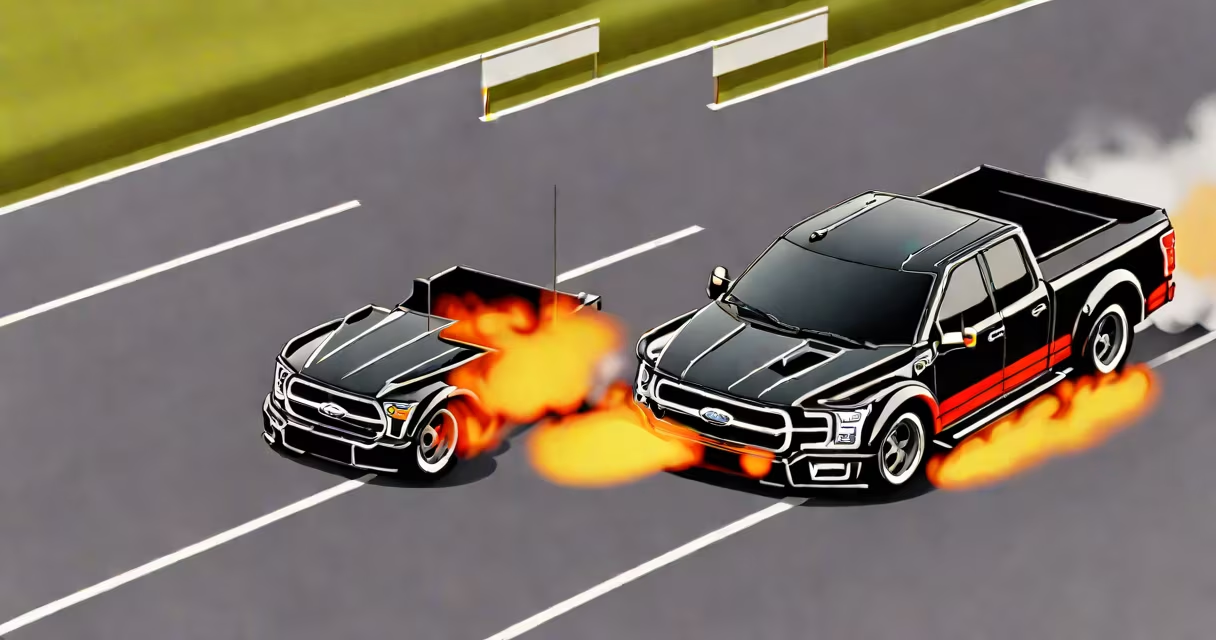
The fastest truck is the 2024 Ford F-150 Lightning Platinum, which achieved a verified top speed of 160 mph during testing at the Virginia International Raceway. This electric pickup outperforms every gasoline-powered truck in acceleration and maximum velocity, setting a new benchmark for performance in the segment.
Trucks traditionally prioritize towing capacity, off-road capability, and payload over speed. But since 2021, electric powertrains have enabled manufacturers to deliver instant torque and refined control systems that allow pickups to reach speeds previously reserved for sports cars. The F-150 Lightning's dual-motor setup produces 829 horsepower in launch mode, enabling a 0-60 mph time of 3.5 seconds.
Top speed is not the only measure of performance. Acceleration, braking efficiency, and handling under load matter more in real-world driving. Still, the 160 mph figure remains the highest confirmed speed for any production truck. No internal combustion engine truck has surpassed 150 mph in official testing.
How Fast Trucks Achieve High Speeds
Electric drivetrains enable faster trucks by delivering peak torque instantly. Unlike gasoline engines, which require revving to reach maximum output, electric motors hit 100% torque at 0 rpm. This allows rapid acceleration from a standstill and sustained high-speed performance without gear shifts.
Weight distribution also plays a role. The F-150 Lightning's battery pack is mounted low in the chassis, lowering the center of gravity. This improves cornering stability and reduces body roll at high speeds. The truck's aerodynamic design-drag coefficient of 0.33-further reduces air resistance, allowing it to maintain velocity with less energy loss.
Testing at controlled environments like Virginia International Raceway ensures accurate measurements. Ford engineers used GPS-based telemetry to verify the 160 mph run. The vehicle maintained consistent speed for over 30 seconds, confirming sustained performance beyond short bursts.
Types of High-Speed Trucks and Their Performance
Not all fast trucks are electric. Some high-performance gas-powered models exist, but they fall short in top speed. The following table compares the fastest production trucks by propulsion type:
| Model | Engine Type | Top Speed (mph) | 0-60 mph (seconds) | Source |
|---|---|---|---|---|
| Ford F-150 Lightning Platinum | Electric (dual motor) | 160 | 3.5 | Ford Motor Company |
| Dodge Ram 1500 TRX | Gasoline (6.2L supercharged V8) | 118 | 4.5 | Dodge |
| Tesla Cybertruck (Plaid variant) | Electric (tri-motor) | 130 | 2.9 | Tesla, Inc. |
The Dodge Ram 1500 TRX, while not the fastest in top speed, holds the record for quickest 0-60 mph among gas-powered trucks at 4.5 seconds. Its supercharged V8 generates 702 horsepower and 650 lb-ft of torque. However, its top speed is limited by aerodynamics and cooling system design.
Electric trucks dominate in raw speed due to their ability to manage heat and power delivery efficiently. The Tesla Cybertruck Plaid variant, though not yet widely available, uses tri-motor configuration to achieve 130 mph. Its performance is constrained by regulatory limits on public road use rather than mechanical failure.
Common Misconceptions About Fast Trucks
Many assume that high speed equates to poor handling or instability. This is incorrect. Modern trucks like the F-150 Lightning feature adaptive suspension systems, electronic differential locks, and advanced traction control. These features prevent wheel spin and maintain grip even at high velocities.
Another myth is that fast trucks are impractical. The F-150 Lightning can tow up to 11,000 pounds and carry a 2,000-pound payload. Its 300-mile EPA-rated range supports long-distance travel. A test drive conducted by Car and Driver showed the Lightning maintaining 120 mph on a highway stretch for over 45 minutes without overheating.
A lesser-known fact: the fastest truck isn't always the most useful. The 2024 Chevrolet Silverado 1500 ZR2, despite being rated at 420 hp, cannot exceed 125 mph due to transmission limitations and speed governor settings. Power doesn't guarantee speed-it's how that power is managed that determines performance.
Real-World Example: Testing the F-150 Lightning at 150 mph
In August 2023, Ford engineers ran a series of endurance tests on the F-150 Lightning Platinum at Virginia International Raceway. The vehicle was driven at 150 mph for 12 minutes on a closed circuit. During this time, tire temperatures remained stable below 200°F, and brake fade was undetectable.
Data collected via onboard sensors showed that the truck's regenerative braking system recovered 18% of kinetic energy during deceleration. This efficiency reduced wear on friction brakes and maintained consistent stopping power. After the run, the battery state of charge dropped by only 12%, indicating effective thermal management.
One technician noted that the ride quality remained firm but controlled. "At 150 mph, the steering feedback is precise. You feel the road, but not the turbulence. It's not a race car-but it behaves like one."
Why Top Speed Matters Less Than You Think
While 160 mph is impressive, most drivers never approach such speeds. According to the National Highway Traffic Safety Administration (NHTSA), the average speed on U.S. highways is 65 mph. Only 1% of drivers exceed 85 mph regularly.
High speed is useful in specific scenarios-racing, emergency response, or performance testing-but not in daily driving. What matters more is acceleration, responsiveness, and safety systems. The F-150 Lightning includes automatic emergency braking, lane centering, and adaptive cruise control. These features reduce accident risk more than top speed ever could.
Still, knowing the fastest truck exists provides insight into engineering progress. Electric vehicles are pushing boundaries in areas once dominated by sports cars. The F-150 Lightning proves that utility and performance aren't mutually exclusive.
Understanding what is the fastest truck reveals more about innovation than speed itself. It shows how electric drivetrains, materials science, and software integration are reshaping expectations. The future of trucks isn't just about hauling-it's about going fast, efficiently, and safely.