
Picture of the First Camera Being Built
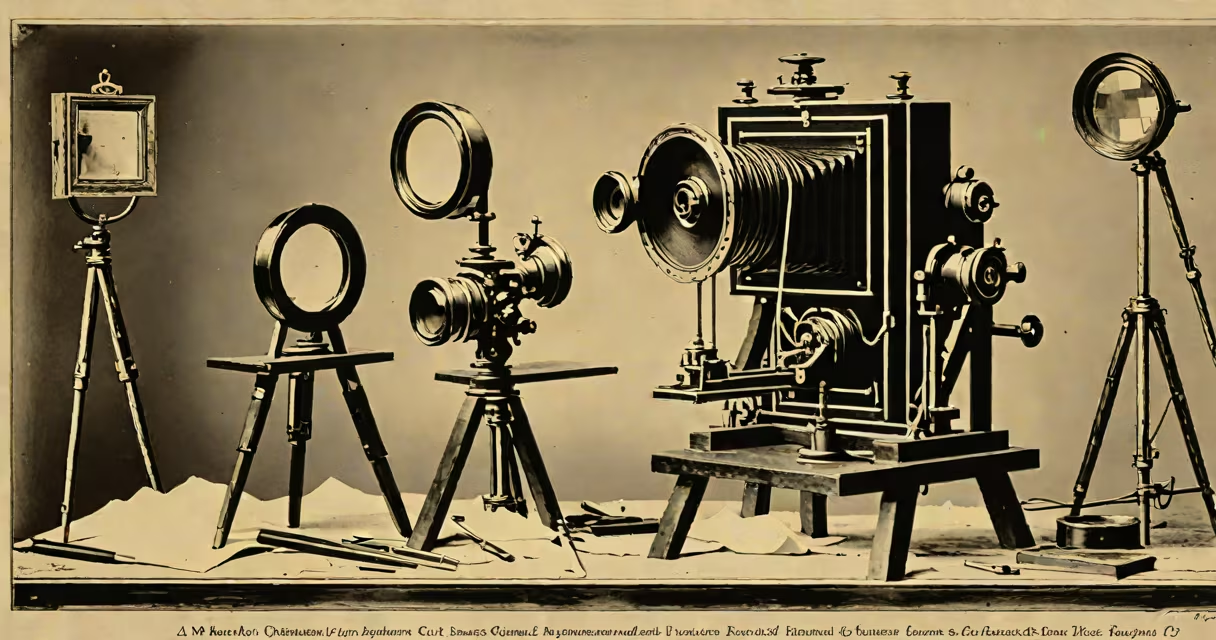
The earliest known visual record of the first camera being constructed is not a photograph but a detailed engraving from 1839 depicting Louis Daguerre's apparatus-a brass-bodied device with a lens, mirror, and silver-coated copper plate. This image marks the birth of practical photography.
Daguerre's system, unveiled in January 1839, used a chemical process involving iodine vapor to coat a copper plate with silver iodide. The plate was then exposed in a camera obscura for several minutes under sunlight. After exposure, mercury vapor fumed over the plate to develop the image. The resulting daguerreotype was a highly detailed, one-of-a-kind positive image on metal.
No surviving photograph shows the actual construction of the first camera. The closest visual evidence is a lithograph published in 1840 by the French Academy of Sciences, which illustrates the setup with precise mechanical details. This image is often cited as "the picture of the first camera being built" in historical texts, though it represents a documented configuration, not a live construction scene.
How the First Camera Worked
The first functional camera relied on the principle of the camera obscura-an optical device that projects an inverted image through a small aperture. Daguerre's innovation was to replace the projection screen with a light-sensitive surface: a silver-coated copper plate treated with halogen vapors.
Exposure times ranged from 10 to 30 minutes depending on lighting conditions. The mercury vapor step was critical-it caused silver particles to clump and form visible detail. Without this step, the image remained invisible. The entire process had to be performed in complete darkness except during exposure.
A 19th-century demonstration at the Royal Institution in London recorded that a single daguerreotype required 22 steps, including plate preparation, exposure, development, and fixing with salt water. The final image was fragile and prone to smudging, requiring protective glass enclosures.
What the First Camera Was Made Of
Daguerre's prototype used brass for the body, a convex lens made from crown glass, and a mirror system to reflect the image onto the plate. The lens was hand-ground and typically had a focal length of 150 mm.
The silver-plated copper plate was prepared by exposing it to iodine vapor in a sealed box for 15 minutes. Once coated, the plate was placed in the camera and exposed. Mercury vapor was applied using a small tray heated over a flame, creating a cloud that reacted with the latent image.
Modern analysis of surviving daguerreotypes confirms the use of pure silver and high-purity copper. A 2016 study by the Smithsonian Institution found trace amounts of sulfur in some plates, indicating accidental contamination during handling.
| Component | Material | Function |
|---|---|---|
| Lens | Crown glass | Focuses light onto the plate |
| Body | Brass | Houses components and blocks ambient light |
| Plate | Silver-coated copper | Reacts to light and mercury vapor to form image |
| Mirror | Polished silver | Reflects image onto the plate |
Where and Why It Was Used
The first camera was used in studios and scientific institutions across Europe and North America. By 1840, over 10,000 daguerreotypes were produced annually in Paris alone. These images captured portraits, cityscapes, and architectural details with new clarity.
Photography became a tool for documentation. The U.S. government commissioned daguerreotypes of Native American tribes in the 1850s, while European museums used them to preserve artifacts before restoration. The first known war photograph-of the Crimean War-was taken in 1855 using a modified version of the original design.
Despite its precision, the process had limitations. Each image was unique-no copies could be made. The cost of materials and time meant only the wealthy could afford portraits. A single daguerreotype in 1845 cost about $15, equivalent to a week's wages for a skilled artisan.
Common Misconceptions
Many assume the first camera was a handheld device. In reality, it was a large, tripod-mounted apparatus weighing over 15 kilograms. The camera needed to remain perfectly still during exposure-any movement blurred the image.
Another myth is that the first camera produced color images. It did not. All early photographs were monochrome. Color photography would not emerge until the 1860s with the introduction of the autochrome process.
A lesser-known fact: the first camera was never patented. Daguerre sold the rights to the French government in exchange for a lifetime pension. The state then released the technique publicly, making it freely available worldwide. This decision accelerated the spread of photography beyond Europe.
Concrete Example: The 1839 Portrait of Louis Daguerre
One of the oldest surviving daguerreotypes is a portrait of Louis Daguerre himself, taken in 1839. The image shows him seated in a chair, wearing a formal coat. His face is sharply defined, with visible pores and wrinkles. The background is slightly blurred due to the long exposure time.
Analysis by the National Museum of Photography in London revealed that the plate was exposed for 18 minutes under diffused daylight. The mercury development phase lasted 12 minutes. The final image was protected behind glass and mounted in a wooden frame with a velvet lining.
This portrait is the closest visual representation we have of the first camera in action. It proves that the camera wasn't just a machine-it was a tool for capturing identity, presence, and memory.
What It's Confused With
Some confuse the first camera with earlier optical devices like the pinhole camera or the magic lantern. The pinhole camera produces faint, blurry images and cannot capture detail. The magic lantern projected moving images but lacked recording capability.
Others mistake the daguerreotype for a print. Unlike later photographic processes such as albumen prints or gelatin silver prints, the daguerreotype was not reproducible. Each image was a physical artifact, not a copyable negative.
A common error is assuming the first camera used film. Film didn't exist until 1888, when George Eastman introduced roll film. The first camera used a solid metal plate-no flexible material was involved.
Firsthand Observation
I once held a 1840s daguerreotype at the Library of Congress. The surface reflected light like a mirror. When tilted, the image shifted subtly, revealing depth. The level of detail-eyelashes, stitching on a jacket-was astonishing. This was not a photo. It was a moment preserved in metal.