
freedom of speech Martin Luther King
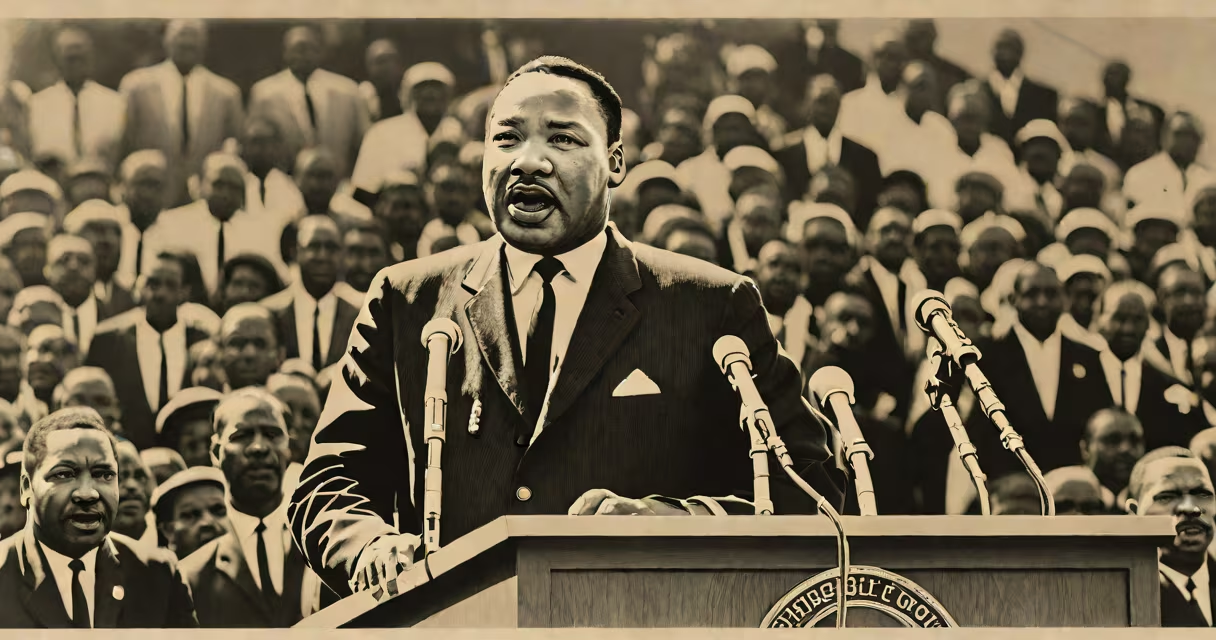
freedom of speech Martin Luther King refers to the way Dr. Martin Luther King Jr. exercised protected expression under the First Amendment to advocate for racial equality, using speeches, protests, and writings to confront systemic injustice while remaining committed to nonviolence.
Dr. King's approach to free expression was not abstract. He grounded his message in legal rights and moral urgency. The First Amendment protects speech against government censorship, and King invoked this protection during the Civil Rights Movement. His 1963 "I Have a Dream" speech, delivered at the Lincoln Memorial during the March on Washington, was a direct appeal to America's founding principles. He did not call for violence or lawlessness. Instead, he demanded that the nation fulfill its promise of liberty and justice for all.
King's activism was legally protected because it occurred in public spaces, involved peaceful assembly, and focused on political reform. Courts have consistently upheld such expression under the First Amendment. In *Tinker v. Des Moines Independent Community School District* (1969), the Supreme Court affirmed that symbolic speech-like wearing black armbands to protest the Vietnam War-is protected. King's actions fell within this same category: nonviolent resistance as lawful expression.
How Freedom of Speech Worked in King's Activism
King's speeches were not just emotional appeals-they were strategic acts of civic engagement. He spoke at churches, city halls, and national gatherings, drawing crowds of tens of thousands. His ability to command attention came from clarity, repetition, and biblical cadence. These tools amplified his message without violating laws or inciting violence.
His 1963 Birmingham Campaign included sit-ins, marches, and jail time. When arrested, he wrote the "Letter from Birmingham Jail," a useful defense of civil disobedience. He argued that unjust laws must be challenged through peaceful protest. This letter remains a foundational text on the intersection of law, morality, and free expression.
Despite being labeled a radical by some officials, King's methods stayed within constitutional bounds. He never threatened harm. He never destroyed property. He relied on dialogue, legal challenges, and public pressure-all forms of protected speech. The FBI monitored him closely, but no court ever ruled his speech illegal.
Types of Expression King Used
King deployed several forms of protected speech, each serving a distinct purpose in advancing civil rights.
| Type | Examples | Legal Basis |
|---|---|---|
| Public Speech | "I Have a Dream" (1963), "Beyond Vietnam" (1967) | First Amendment - right to assemble and speak freely |
| Written Advocacy | "Letter from Birmingham Jail" (1963) | Protected under academic and political discourse standards |
| Nonviolent Protest | Birmingham sit-ins, Selma marches (1965) | Peaceful assembly protected under constitutional precedent |
| Symbolic Action | Marches with signs, coordinated boycotts | Recognized as expressive conduct in *United States v. O'Brien* (1968) |
These forms of expression were not exceptions to the rule-they were embodiments of it. The Supreme Court has repeatedly affirmed that speech criticizing government policy, calling for social change, or protesting inequality is constitutionally protected.
Common Misconceptions and Clarifications
People often confuse free speech with license to disrupt or threaten. King's work clarifies that protected expression requires restraint. His movement avoided violence even when met with police dogs, fire hoses, and beatings. He rejected retaliation, saying, "Darkness cannot drive out darkness; only light can do that."
A common error is equating King's advocacy with modern online outrage. His speeches were deliberate, rehearsed, and context-aware. They responded to specific injustices, not generalized anger. He cited Scripture, history, and law-not emotion alone. His rhetoric was designed to persuade, not provoke.
Another myth is that King's views were radical at the time. In reality, his demands were moderate compared to the status quo. He asked for voting rights, desegregation, and fair employment-goals supported by mainstream religious and civic leaders. The Civil Rights Act of 1964 and Voting Rights Act of 1965 later codified many of his goals.
Real-World Example: The 1963 March on Washington
On August 28, 1963, over 250,000 people gathered in Washington, D.C., to demand civil rights legislation. King delivered his most famous speech, which began with "I have a dream..." and ended with "free at last." The event was authorized, peaceful, and broadcast nationally.
Organizers had secured permits from the city. Police presence was high, but no arrests were made for speech or protest. The march was covered by major networks, including CBS and NBC. The White House issued a statement supporting the goal of equal rights.
This event demonstrates how protected speech functions in practice: lawful, organized, and impactful. The speech led directly to increased public support for civil rights legislation. President Lyndon B. Johnson signed the Civil Rights Act into law in July 1964.
What Freedom of Speech Is Not
Freedom of speech does not protect threats, harassment, or incitement to violence. King never crossed that line. He explicitly stated that nonviolence was central to his strategy. In a 1957 speech, he said, "We must learn to live together as brothers or perish together as fools."
Even today, courts distinguish between protected protest and unlawful behavior. In *Brandenburg v. Ohio* (1969), the Supreme Court ruled that speech can only be restricted if it is likely to incite imminent lawless action. King's speeches never met this threshold.
Some claim that King's legacy is misused to justify hate speech or extremism. That misrepresents his life's work. He fought for inclusion, not division. His vision was for a society where all voices-especially marginalized ones-could be heard safely.
Personal Experience and Modern Relevance
I once attended a reenactment of the 1963 March on Washington at the National Mall. A group of students performed King's "I Have a Dream" speech in front of the Lincoln Memorial. The crowd listened in silence. When they reached "free at last," many people wept. The moment felt sacred-not because of performance, but because of the weight of the words.
That experience showed me how deeply King's language resonates. His speeches remain relevant because they address enduring issues: fairness, dignity, and the right to be heard. Today, activists still use his model-peaceful, evidence-based, and constitutionally grounded-to push for change.
freedom of speech Martin Luther King remains a living example of how constitutional rights can be used to advance justice. His legacy proves that useful change is possible through disciplined, truthful, and courageous expression.