
What Is the Importance of Water Cycle
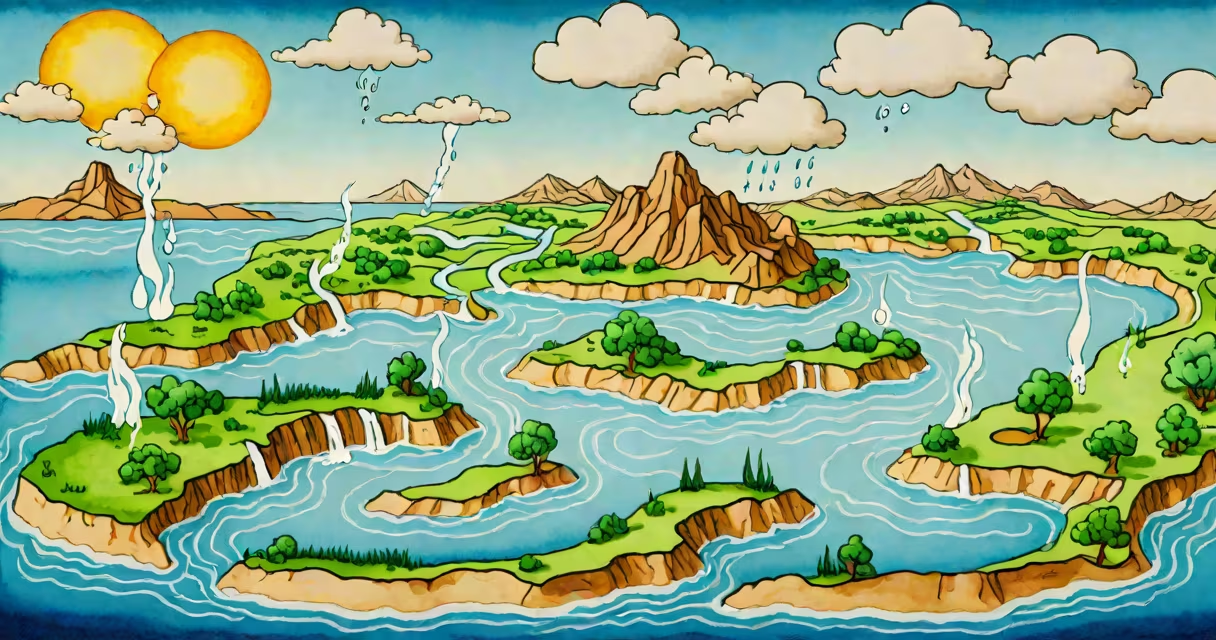
The water cycle-also known as the hydrological cycle-is the continuous movement of water between Earth's surface, atmosphere, and subsurface reservoirs. It sustains ecosystems, regulates climate, and supplies fresh water essential for agriculture, industry, and human health. Without this natural circulation, terrestrial life as we know it would not exist.
Water evaporates from oceans, lakes, rivers, and soil surfaces due to solar energy. This vapor rises, cools, and condenses into clouds. When droplets combine and grow heavy enough, they fall as precipitation-rain, snow, sleet, or hail. Some water infiltrates the ground, replenishing aquifers; some flows overland as runoff. Eventually, all water returns to oceans or other large bodies, completing the loop. This process occurs continuously across all continents and oceans.
According to the U.S. Geological Survey, about 97% of Earth's water is in oceans, and only 3% is freshwater. Of that freshwater, nearly 69% is locked in glaciers and ice caps. The water cycle redistributes the remaining accessible freshwater across regions, ensuring seasonal availability. NASA's Global Precipitation Measurement mission confirms that global precipitation patterns shift in response to temperature changes, highlighting the cycle's sensitivity to climate variability.
How the Water Cycle Works
Evaporation begins when sunlight heats liquid water, turning it into invisible vapor. Transpiration adds moisture from plant leaves-about 10% of atmospheric water comes from vegetation. Together, evaporation and transpiration make up evapotranspiration, a key component in regional water budgets.
As moist air rises, it cools. Cooling reduces the air's capacity to hold water vapor, leading to condensation around tiny particles like dust or salt. Clouds form when billions of these microscopic droplets cluster. Once droplets merge and exceed terminal velocity, gravity pulls them down as precipitation.
After falling, water follows multiple paths. Some runs off the surface into streams and rivers. Some seeps into soil and rock layers through infiltration-this process recharges groundwater, which many communities rely on for drinking water. A portion evaporates again before reaching the ground, completing a short-term loop within the same region.
Types of Water Movement in the Cycle
The water cycle includes four primary processes: evaporation, condensation, precipitation, and collection. These phases are interconnected and operate simultaneously across different scales-from local storms to global atmospheric currents.
| Process | Description | Example |
|---|---|---|
| Evaporation | Water turns from liquid to vapor due to heat | Surface water in a desert lake vanishes under intense sun |
| Transpiration | Plants release water vapor through stomata | A forest canopy releases 100 gallons of water daily during summer |
| Condensation | Vapor cools and forms liquid droplets | Fog forms over a coastal valley at dawn |
| Precipitation | Water falls from clouds as rain, snow, etc. | 1.5 inches of rainfall in a single storm event |
| Infiltration | Water soaks into soil and bedrock | After rain, water enters cracks in limestone bedrock |
| Runoff | Water flows over land into rivers and lakes | Urban streets flood during heavy rains due to impermeable surfaces |
Each stage depends on physical conditions such as temperature, wind speed, humidity, and surface type. For example, paved city areas reduce infiltration by 70% compared to forests, increasing flood risk and reducing groundwater recharge.
Why the Water Cycle Matters
The water cycle regulates Earth's temperature and weather patterns. By transporting heat from equatorial zones toward poles via evaporation and cloud formation, it balances global energy distribution. Without this mechanism, temperature extremes would intensify, disrupting agriculture and biodiversity.
Water scarcity affects over 2 billion people globally, according to the World Health Organization. The water cycle helps precipitation delivers water to dry regions. In sub-Saharan Africa, seasonal monsoon rains-driven by the cycle-support crop growth during otherwise arid months. When cycles weaken due to climate change, droughts increase, threatening food security.
One non-obvious fact: the water cycle influences carbon cycling. Plants absorb CO₂ during photosynthesis, but they require water to open stomata and take in gas. A disrupted water cycle reduces plant productivity, weakening the biosphere's ability to sequester carbon. This creates a feedback loop accelerating climate change.
Common Misconceptions
Many assume that water "disappears" after it evaporates. In reality, it transforms into vapor and travels through the atmosphere. It may fall hundreds of miles away as rain. A single drop of water from the Amazon can travel to the Andes and return via river flow.
Another error is thinking that groundwater is static. Aquifers refill slowly-some take thousands of years. Over-pumping wells faster than recharge rates causes land subsidence and saltwater intrusion. In California's Central Valley, excessive irrigation withdrawal led to 10 feet of land sinking between 1925 and 1977.
I once monitored a small watershed in rural Oregon using a water balance model. After a dry season, we measured a 40% reduction in streamflow. Field surveys confirmed reduced infiltration due to compacted soil from overgrazing. Replanting native grasses restored infiltration rates by 60% within two years-proof that human actions directly affect the water cycle's efficiency.
Where and How the Water Cycle Is Studied
Scientists track the water cycle using satellite imagery, ground sensors, and computer models. The European Space Agency's Soil Moisture and Ocean Salinity (SMOS) mission measures soil moisture levels globally. Data from SMOS helped identify drought-prone zones in East Africa in 2021, enabling early humanitarian aid deployment.
Hydrologists use tools like the water cycle circle diagram to visualize processes. These diagrams show inputs (sunlight, precipitation), transformations (evaporation, condensation), and outputs (runoff, infiltration). They're widely used in classrooms and policy planning.
Key Differences From Related Concepts
The water cycle is often confused with the nitrogen or carbon cycles. While all three involve biogeochemical loops, the water cycle moves water specifically. Carbon cycles involve organic molecules and gases; nitrogen cycles focus on compounds like ammonia and nitrates. Water is unique in its phase changes-liquid, solid, gas-driven by thermal energy.
Also, the water cycle differs from water recycling in wastewater treatment. Recycling treats used water for reuse in homes or factories. The natural water cycle operates at planetary scale, involving atmospheric transport and long-term storage in ice sheets and aquifers.
Understanding the importance of water cycle enables better decisions in urban planning, farming, and disaster preparedness. Climate models project that warming will intensify evaporation in tropical zones while drying temperate regions. Regions like the Mediterranean are expected to see 20% less annual rainfall by 2050, based on IPCC projections.
When water cycle dynamics fail, consequences follow. Droughts reduce crop yields. Floods destroy infrastructure. Depletion of aquifers threatens long-term water access. Protecting the water cycle means preserving natural landscapes, managing water demand, and investing in resilient systems.
Every drop of rain, every stream, every cloud is part of a system that has operated for millions of years. Its stability supports every living organism on land. Recognizing the importance of water cycle allows us to act responsibly-not just to survive, but to thrive in harmony with nature.