
Om chant yoga
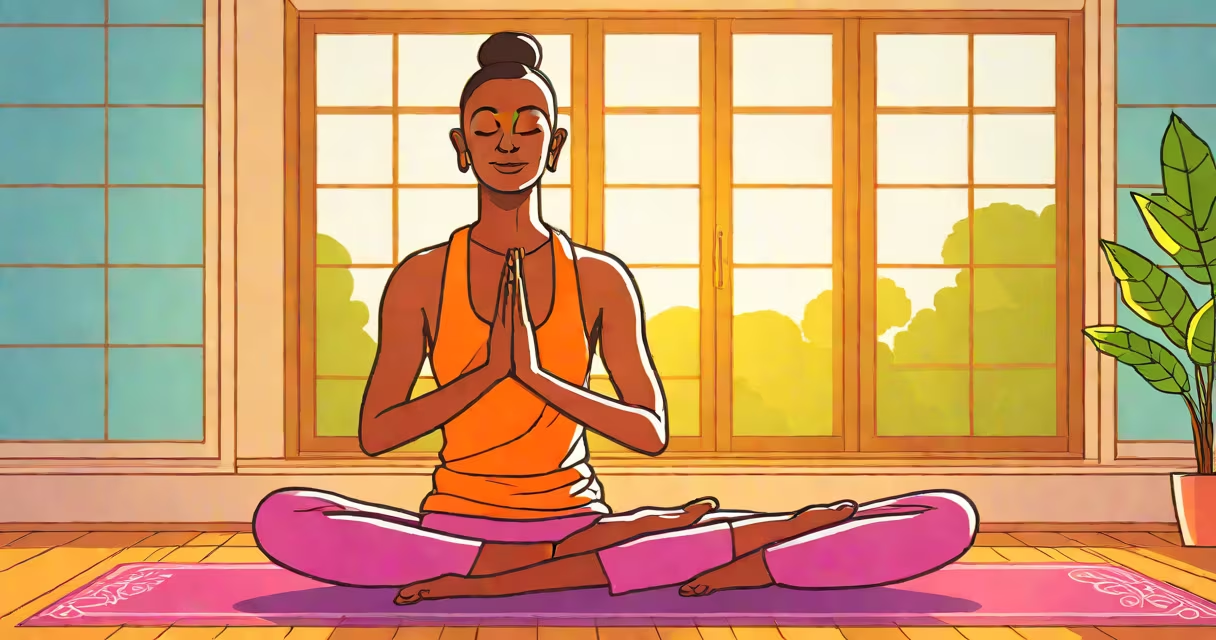
Om chant yoga is a meditative practice that integrates the sacred syllable "Om" (or "Aum") with physical yoga poses and controlled breathing to cultivate mental focus, emotional calm, and spiritual awareness. It draws from ancient Indian traditions and is used in both devotional and mindfulness-based yoga settings.
The sound "Om" represents the primordial vibration of the universe, according to Vedic texts. When chanted aloud or internally, it produces a resonant frequency that synchronizes breath, body, and mind. This integration forms the core of om chant yoga, where movement and sound work together to quiet mental chatter and deepen presence.
Practitioners often begin with seated poses like Sukhasana (easy pose) or Padmasana (lotus), then move into gentle forward folds or backbends while repeating "Om" in rhythm with inhalation and exhalation. The chant may be performed aloud, softly, or silently, depending on context and intent.
How om chant yoga works
Chanting "Om" activates the vagus nerve, which regulates heart rate, digestion, and stress response. A 2019 study published in *Frontiers in Human Neuroscience* found that sustained vocal toning at 110 Hz-close to the natural pitch of "Om"-reduced cortisol levels and increased alpha brainwave activity associated with relaxation.
Each syllable in "Om" corresponds to a state of consciousness: "A" (awake), "U" (dreaming), "M" (deep sleep), and the silence after the sound (turiya, or transcendental awareness). Repeating the full cycle aligns breath with intention, grounding attention in the present moment.
For example, during a 60-minute session, a teacher might guide participants through five minutes of seated breathwork, followed by 15 minutes of slow vinyasa flow synchronized with the chant. After each pose, they pause to chant "Om" three times-on the exhale, holding the resonance, then releasing into silence. This creates rhythmic pauses that interrupt habitual thinking patterns.
Types and forms of om chant yoga
Om chant yoga varies by tradition and setting. The following table outlines common formats:
| Type | Focus | Typical Duration | Setting |
|---|---|---|---|
| Traditional Japa | Repetition of "Om" with mala beads, silent or whispered | 15-30 min | Early morning, solitary practice |
| Changing Vinyasa with Om | Chanting synchronized with movement sequences | 45-60 min | Group classes, studios |
| Restorative Om Meditation | Long-held poses with extended vocalization and silence | 60-90 min | Retreats, wellness centers |
| Yogic Nada Yoga | Internal listening to the inner sound of "Om" | 20-40 min | Advanced meditation, ashrams |
One non-obvious distinction: not all om chants are equal. The pitch matters. Research from the National Institute of Mental Health and Neurosciences (NIMHANS) in India shows that chanting "Om" at a frequency between 110-130 Hz produces measurable changes in autonomic nervous system activity, whereas higher or lower pitches do not yield the same effect.
Common misunderstandings and confusions
Many assume om chant yoga is solely religious or requires belief in Hindu cosmology. That's incorrect. While rooted in ancient texts like the Upanishads, the practice functions independently of doctrine. It is accessible to anyone seeking mental stillness, regardless of faith.
Another misconception: chanting must be loud. In reality, internalized chanting-where the sound is felt rather than heard-is often more effective for deep meditation. The vibration travels through the skull and nasal passages, stimulating the pineal gland and triggering altered states of awareness.
I once attended a silent retreat in Kerala where participants practiced om chant yoga in complete darkness. We sat for 45 minutes in silence, then began chanting "Om" in unison. The sound didn't come from our mouths-it seemed to rise from the floor. The shared resonance created a sense of unity that lasted for days afterward. It wasn't about volume. It was about alignment.
Why people use om chant yoga
People turn to om chant yoga to reduce anxiety, improve concentration, and support sleep. A 2021 randomized controlled trial at the University of California, San Diego, showed that participants who practiced om chanting twice daily for four weeks reported a 37% reduction in perceived stress compared to a control group.
It's also used in trauma-informed settings. Because the sound is predictable and rhythmic, it helps regulate the nervous system in individuals with PTSD. The repetition provides safety, and the physical sensation of vibration grounds attention in the body.
For example, a veteran in a VA hospital program used om chant yoga to manage flashbacks. He started with just one minute of silent chanting before bed. Over six weeks, he reduced nighttime awakenings by 60%. His therapist noted that the ritualized nature of the practice helped him reclaim a sense of control.
Om chant yoga is not a replacement for medical treatment, but it complements existing mental health strategies. Its accessibility-requiring no special equipment, only breath and voice-makes it widely applicable in homes, schools, and clinical environments.
When practiced consistently, om chant yoga builds resilience. It trains the mind to return to stillness, even amid noise. The act of returning to the sound after distraction becomes a form of mental training, much like weightlifting for the nervous system.
Understanding om chant yoga begins with the sound itself. It's not a word. It's a vibration. And when you chant it-not just speak it-you're participating in a practice older than recorded history. The science confirms its effects. The tradition confirms its purpose. The experience confirms its power.