
What Are Shoe Size Measured In
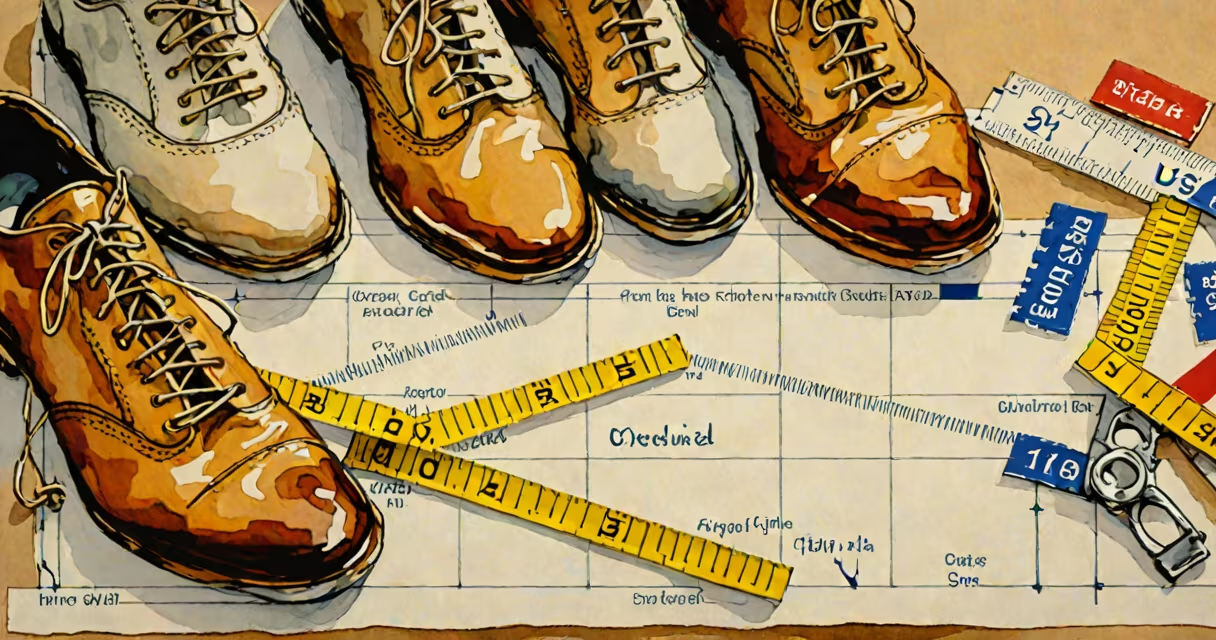
Shoe size is measured using standardized systems-primarily US, UK, and EU-that define foot length and width in inches or centimeters. These systems vary by region and are not interchangeable without conversion.
The US system uses inches and fractions of an inch, with sizes increasing in half-unit increments (e.g., 7, 7.5, 8). The UK system follows a similar pattern but starts at size 1 for children and uses whole numbers and half sizes. The EU system measures foot length in centimeters and rounds to the nearest half-centimeter (e.g., 25.5 cm = size 41).
Each system assigns a unique number to a specific foot length. For example, a foot measuring 10 inches long corresponds to size 10 in US men's sizing, size 9 in UK men's sizing, and size 43 in EU men's sizing. These differences arise from historical development and regional standards, not arbitrary choices.
How Shoe Sizing Systems Work
Shoe size systems are based on foot length, typically measured from the heel to the longest toe. The US system defines a size increment as 1/3 inch (approximately 8.5 mm), meaning each half-size increase adds about 4.25 mm of length. This standard applies to both men's and women's sizes, though separate charts exist due to average foot size differences.
The UK system uses a slightly different baseline. A size 1 in UK men's shoes equals 23.5 cm of foot length. Each full size increases by 1/3 inch (8.5 mm), aligning closely with the US system but offset by one size. For example, a US size 10 equates to UK size 9, and a US size 11 matches UK size 10.
The EU system differs -it uses centimeters and rounds to the nearest 0.5 cm. A foot length of 26.5 cm corresponds to EU size 42. Unlike US and UK systems, EU sizes do not include half-sizes beyond 0.5 cm, which can result in less granularity for narrow foot widths.
Types of Shoe Size Systems
Three primary systems are used globally. The table below compares them side-by-side using a 10-inch foot as reference:
| Foot Length | US Men's | UK Men's | EU Men's |
|---|---|---|---|
| 10 inches (25.4 cm) | 10 | 9 | 43 |
| 10.5 inches (26.7 cm) | 11 | 10 | 44 |
| 11 inches (27.9 cm) | 12 | 11 | 45 |
Women's sizing uses different base lengths. A US women's size 8 corresponds to 9.5 inches (24.1 cm), while the equivalent UK size is 7.5 and EU size is 39.5. This divergence means that a woman wearing US size 8 may find her feet too tight in a UK size 7.5 or EU size 39.5 if she relies solely on the number.
Width is another factor. Most systems offer width options (e.g., B, D, EE), but these are not always consistent across brands. A US D width is roughly equivalent to a UK medium, but a US EE width may correspond to a UK wide or extra-wide depending on the manufacturer.
Common Confusions and Corrections
Many assume that EU sizes are universal or that US sizes are the global standard. This is incorrect. EU sizing is widely used in Europe and parts of Asia, but it is not adopted uniformly. A size 42 in France may differ slightly from a size 42 in Germany due to national variations in measurement tolerance.
Another misconception is that shoe size numbers reflect actual foot length. They do not. A US size 10 does not mean the foot is 10 inches long. Instead, it represents a standardized length that includes a margin for comfort and movement. According to the American Podiatric Medical Association, a proper fit allows ¾ inch (1.9 cm) of space between the longest toe and the shoe's front edge.
One non-obvious fact: shoe size systems were not developed by medical professionals. The US system originated in the 19th century as a trade standard among shoemakers in New York City. The UK system evolved from a medieval measurement called the "barleycorn," where one barleycorn equaled 1/3 inch. The EU system was formalized in 1994 under ISO 9400, which standardized measurements across member states.
Practical Example: Converting Sizes
Suppose someone has a foot measuring 26.8 cm. To convert this to US men's sizing:
- Find the closest EU size: 26.8 cm rounds to EU size 44.
- Use a conversion chart: EU size 44 equals US size 11.
- Verify with a trusted source: The U.S. Department of Commerce's Bureau of International Trade provides official conversion tables.
When shopping online, cross-referencing multiple systems prevents misfit. For example, a person with a 10.25-inch foot should consider US size 10.5, UK size 9.5, and EU size 44.5. Without checking, they might order a US size 11, which would be too large.
I once ordered a pair of running shoes online using only the EU size listed on a product page. My foot measured 26.3 cm, so I selected EU size 43. After receiving them, I noticed the toe box felt tight. I checked the US equivalent-size 10-and realized the brand used a narrower last (footbed mold). Switching to a US size 10 with a wider width resolved the issue.
Why Accurate Measurement Matters
Incorrect sizing leads to discomfort, blisters, and long-term foot problems. The American Academy of Orthopaedic Surgeons reports that ill-fitting shoes contribute to 75% of foot pain cases seen in clinics. Poor fit increases pressure on the ball of the foot, leading to conditions like metatarsalgia and bunions.
For athletes, even a 0.5 cm mismatch can affect performance. A study published in the Journal of Sports Science and Medicine found that runners wearing shoes that were half a size too big experienced a 12% drop in stride efficiency due to instability during push-off.
Always measure your feet ultimately when they're slightly swollen. Use a ruler or a printable foot template. Compare results against multiple conversion charts. When in doubt, consult a professional fitter at a specialty store.